Fall Management & Over-wintering
After the honey harvest is complete, beekeepers begin working to ensure their hives are optimally prepared to go through winter. The bees that emerge in late fall are known as ‘winter bees’; they will hopefully survive all winter until the queen starts laying again, typically in February. These bees will survive 4-5 months since they are not foraging. Because the queen stops or minimally lays eggs during winter, it is important for the beekeeper to support keeping the winter bees alive.
Four things will kill a colony over winter: unhealthy bees; not enough bees; starvation; and moisture.
Varroa monitoring/treatments/controls need to continue going into fall and through winter. Some beekeepers use extended oxalic preparations, as these can be left in place when boxes aren’t opened all winter. Not managing varroa in the colony in late summer is essential for colony survival in winter. High mite loads can lead to unhealthy bees; when bees die from the effects of varroa, the colony may not have enough bees to keep the cluster warm. Healthy bees and colony strength are essential. Feeding pollen in fall can prompt the queen to continue laying before she lays the winter bees. If your colony is weak (not enough bees), consider combining a weak colony with another weak colony; doing this early in the fall gives the bees time to adjust to the change.
Tracheal mites can be managed by feeding or using a mite treatment preparation that contains thymol. If temperatures are still warm, the bees can be fed or sprayed with syrup containing ProHealth, which contains thymol, or fed a tracheal mite grease patty. Apitablets and Apivar contain thymol as well as other nutrients. Nosema is often seen in winter as they often cannot do a cleansing flight. The only treatment for nosema currently is Fumagilin B used as a spray. Maintaining a strong, healthy colony is the best defense against many hive problems.
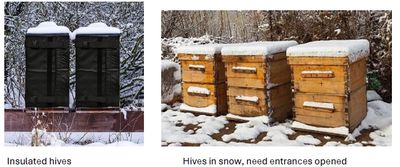
Preparation for winter includes preparing the hive to tolerate cold wet weather we experience in Lewis County. Some beekeepers prepare a ‘condensing hive’ by insulating the lid with close to R-30 insulation and the hive bodies with around R 7-10 or greater. The screened bottom board mite tray is inserted and left in place. If a moisture or quilt box is used, it is filled with wood shavings or other moisture absorbing material to keep the hive bodies dry. Supers and queen excluders are removed. If a solid bottom board is used, use small shims to tip the hive very slightly towards the front so any moisture from the lid will drip down the box front and not onto the bees. Mice guards are placed in early fall to keep mice out of the hive . Sweeping dead bees out of the bottom during winter is important for keeping the entrance from becoming blocked during times the bees cannot get out to remove them.
There are several videos that explain condensing versus ventilating hives; here are a couple.
- https://www.youtube.com/watch?v=S77Ei0AezEA Peggy Desantos with Hive Hugger
- https://youtu.be/oQQ1283rmb4 Sweet Sadie Honey explains condensing hives
Beekeepers have available complete hive bodies made of styrofoam which are becoming a popular choice for a condensing hive; one seen in our area is the Hive IQ. These hives don’t require a moisture box. A condensing hive helps the colony survive during winter by preventing moisture, and keeping the hive warm so the bees do not have to work as hard to maintain the hive temperature. If the inside of the hive is warm, the bees are more likely to travel to outside frames for food, therefore reducing the chance of starvation. It doesn’t hurt to add food during winter. Food must be in solid form (fondant, sugar block), no syrup. The hive body is not opened during winter; the lid is briefly lifted long enough to place food and closed again. Hive bodies are not opened even on a sunny 55 degree day in winter – the bees will chill and expend a lot of energy getting the entire hive warm again. The only thing a beekeeper should do until consistently warm day and nighttime temperatures is briefly lift a lid or moisture box to place food on the top of the frames. Syrup needs to stay warm so it is not used until around April, again when temperatures are around 55 –60 day and night.
Proper hive placement to protect from wind, rain or snow is important. If you experience snow, be sure to check that your hive entrance is not blocked. Some beekeepers place a corrugated plastic board (similar to political yard signs which can be picked up following an election) on top of the hive lid and weigh it down with a block or large rock to minimize rain at the hive front.
Overwintered hive: alive or dead?
If you see bees flying out of the hive, your hive has survived your work to prepare for winter! Be sure to continue to provide supplemental food to support the balance between production of new bees and the die off of old bees in the spring. Spring management begins again!