Managing Diseases and Parasites
Integrated Pest Management (IPM)
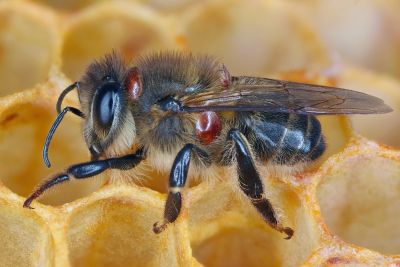
IPM is essential for strong colonies and survival of your bees. It consists of monitoring your hive, managing or treating when needed, and monitoring post-treatment effectiveness. Managing tracheal mites is another part of an integrated pest management plan. Wasps, ants, and mice may also be problematic.
Varroa mites and the viruses they carry are the most common and destructive problem facing beekeepers today. These mites feed on both adult bees and brood, and reproduce inside sealed brood cells. Testing method detailed instructions for counting mite loads are found on the internet but include from least accurate to most accurate: sticky board under the screen bottom board, sugar roll or shake, and alcohol wash. The sugar and alcohol tests each test a sample of about 300 bees. What is important is to test/count, treat as needed, and test the effectiveness of any treatment.
How many mites is too many? One guide suggests 3 mites: 300 bees in spring and 9 mites: 300 bees in early fall are treatment thresholds. The Honey Bee Health Coalition suggests maintaining a mite count below 2-3 mites per 100 bees (or 6-9 in a 300-bee sample). Their comprehensive varroa management paper can be read here: HBHC-Guide_Varroa-Mgmt_8thEd-082422.pdf
Another management guide is from WSU and can be read here:
Each beekeeper needs to develop a plan for testing for mites and treatments they plan to use depending on time of year (some treatments are temperature sensitive, some cannot be applied when honey supers are in place). Becoming familiar with the various mite treatments is an important beekeeper’s responsibility.
Tracheal Mites
Tracheal mites are tiny parasitic mites that infest the bee’s trachea. They feed on a bee’s hemolymph and weaken the colony. One sign of mite infestation can be decreased honey production. Abnormal brood patterns may also be seen. Tracheal mites can only be identified by microscopic exam, or by sending bees to a facility that offers testing. The beekeeper may notice deformed or “K” wings on the bee. It is simpler to proactively treat once or twice a year with a product containing thymol (Apiguard), or provide a winter ‘grease patty. A variety of grease patty recipes can be found on the internet and consist of a solid oil and sugar, with honey or essential oils added.
Mice
Mice are easily managed with the use of an entrance mouse guard.
Yellow Jackets
Yellow jackets can kill a hive; monitoring and eradication are important. Queens generally emerge in February; killing any queens can decrease the number of nests. There are a variety of trapping methods available to make from internet recipes. Consider avoiding any attractant that uses sugar, as these can attract the honeybees as well.
Diseases
The two primary diseases affecting honey bees are American and European Foulbrood. European foulbrood (EFB) is caused by a bacterium and affects young larvae in mid to late spring. Signs and symptoms for EFB and American Foulbrood (AFB) are similar – caps of diseased brood are concave, sometimes punctured, and show a spotty brood pattern with empty cells scattered among capped brood. In AFB, larvae die in their cells after they are capped; larvae in EFB did before the cells are capped. For a severe case of EFB, an antibiotic is required, which must be prescribed by a veterinarian qualified to treat honeybees.
AFB is caused by a spore-forming bacterium; these spores contaminate brood food. Infected larvae change from a healthy pearl white to tan or dark brown and die soon after capping. If a toothpick or matchstick is inserted into a brood cell, the dead body will come out as a stringy, threadlike ¼ inch thread. There is often an unpleasant odor; the hive smells foul. If AFB is confirmed, the hive and bees must be treated with a prescription antibiotic obtained from a veterinarian qualified to treat and use antibiotics on honeybees. Many hobbyist beekeepers burn the hives, bees and equipment as the spores are highly contagious and can remain active for many years.
Chalkbrood is a fungal disease. In early stages, dead larvae are covered with white, fluffy mycelia and swell to the size of the cell. Worker bees attempt to remove the chalkbrood as soon as possible, so the chalky ‘mummies’ may be seen at the hive entrance. Chalkbrood is most often seen in damp early spring conditions. Most colonies generally recover on their own.
Nosema is a fungal disease affecting the midgut of the bee. The most common source of infection is comb contaminated by feces. The spores may be viable for more than a year in feces deposited within a hive. Microscopic analysis is the only way to confirm the presence of Nosema. Discouraging Nosema is done by having good management practices, replacing a third of old frames each year.